To tailor your resume to a job description, pull the must-have skills and key terms from the posting, match each one to real evidence in your experience, then rewrite your summary, reorder your bullets and update your skills using the employer's wording. A tailored resume (or CV, as it is called in India, the UK and much of the world) puts your most relevant experience first and drops what does not matter for this role. It does not mean inventing experience or rewriting from scratch. With a good base resume, it takes about 20 to 30 minutes.
Below is a step-by-step method, followed by a worked example with a sample job description.
Why tailoring works
Recruiters and applicant tracking systems are both looking for a match. A recruiter searching the ATS types in the skills and job titles from their own posting. A recruiter reading your resume checks quickly whether you meet the must-haves. A generic resume makes both of them work harder to see the fit; a tailored one makes it obvious.
How to tailor your resume to a job description in 7 steps
1. Start from a base resume, not your last tailored copy
Keep a complete master resume with every role, project and skill. Duplicate it for each application, so tailoring becomes choosing and reordering rather than rewriting.
2. Mark up the job description
Read the posting twice. On the second pass, highlight:
- Must-have skills and tools, usually under Requirements or Qualifications.
- Nice-to-haves, often marked "preferred" or "a plus".
- Responsibilities that come first or repeat — they are usually the core of the job.
- The exact job title and seniority.
- Domain words: industry, customer type, product type.
3. Map each requirement to your evidence
Make a quick two-column list: each requirement on the left, the bullet or project that proves it on the right. Gaps are fine — note them honestly. If you have the skill but it is not on your resume, add it. If you do not have it, do not claim it.
4. Rewrite your summary for this role
Use the posting's job title if it honestly matches your experience, name the two or three most important requirements you meet, and add one proof point.
5. Reorder and reword your bullets
Move the most relevant bullets to the top of each role. Reword where you describe the same thing differently — "client onboarding" versus "customer implementation". Cut bullets that do nothing for this job to make room for the ones that do.
6. Adjust your skills section
Bring the skills the job asks for to the front of each group, using the posting's spelling. Remove skills that are irrelevant to this role and crowding the list.
7. Check, then send with a matching cover letter
Read the job description against your resume one last time. Then write a short cover letter that picks one or two requirements and shows how you meet them.
Worked example: tailoring for a data analyst job
Here is a shortened job description of the kind you see for mid-level analyst roles in India and the US.
The requirements, marked up
- Must-haves: SQL, Tableau or a similar BI tool, A/B test analysis, presenting to non-technical stakeholders, 2–4 years of experience.
- Nice-to-haves: Python; subscription or e-commerce experience.
- Words to reuse where they fit: customer behaviour, churn, dashboards, A/B testing, stakeholders.
Before and after: the summary
Notice that this candidate uses Power BI, not Tableau. The tailored version does not pretend otherwise. It talks about dashboards and lets the skills section show Power BI, which a recruiter will recognise as a similar BI tool. If you have used Tableau, even in a course project, list it truthfully.
Before and after: the bullets
After
- "Built weekly Power BI dashboards on customer acquisition and repeat purchases, used by marketing and product leads to plan campaigns."
- "Wrote SQL to segment customers by purchase frequency and identified the segment with the highest churn risk, which became the focus of a win-back campaign."
- "Analysed four A/B tests on checkout and pricing pages, reporting results and recommended next steps to the product team."
Before
- "Created weekly reports for the marketing team."
- "Did analysis on customer data."
- "Helped with experiments."
Before and after: the skills line
Before: "Excel, SQL, Power BI, Python, Statistics." After: "SQL (PostgreSQL), Power BI, A/B testing, Python (pandas), Excel, stakeholder presentations." Same skills, reordered and named the way the posting names them.
How to match your resume to a job description: where each keyword goes
Matching is not about repeating keywords. Each kind of phrase in a posting has a natural home on your resume, and it counts most when it sits next to proof.
| In the job description | Example | Where to use it |
|---|---|---|
| Job title | Data Analyst, Customer Insights | The target role under your name and in your summary, if it honestly fits |
| Must-have tools | SQL, Tableau | Skills section, and in the bullet that shows you using them |
| Core responsibility | Analyse churn and customer behaviour | Your first or second bullet for the most relevant role |
| Soft skill with context | Present to non-technical stakeholders | A bullet with a result, not the skills list |
| Domain or industry | Subscription, e-commerce | Summary and the company line of a relevant role |
| Nice-to-have | Python | Skills section, if true; a project bullet if you have one |
When you are done, read your resume as the recruiter would: can they find each must-have in under ten seconds? If not, move it higher.
Tailor faster with AI, then check the result
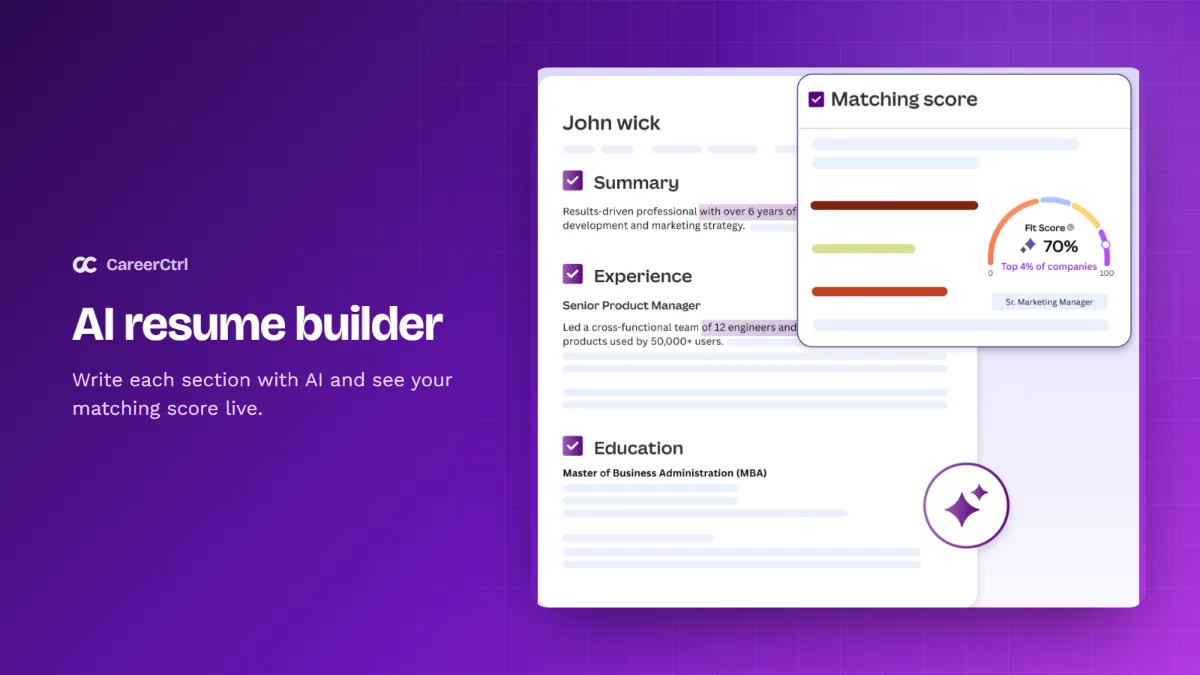
If you apply to several jobs a week, AI can do the first pass. In the CareerCtrl resume builder, AI Tuner's Tailor to a job option takes the job title and the pasted job description and creates a tailored copy of your resume — your original stays unchanged. The Skills tab lists hard and soft skills missing from your resume, with suggested phrases you can add to a role. Every AI change is highlighted, and you can compare before and after with a fresh score, or undo.
Always read the tailored copy before you send it. AI is good at matching language; only you know whether each line is true.
For the cover letter, the AI cover letter generator can draft one from your resume and the same job description, in a Professional, Enthusiastic or Concise tone. On Easy Apply jobs in CareerCtrl Jobs, Write with AI drafts one inside the application form.
How much tailoring is enough?
- Roles you really want: full tailoring — summary, bullet order, wording and skills — plus a specific cover letter.
- Good-fit roles you are applying to in volume: tailor the summary and skills, and reorder your top bullets.
- Long shots: decide whether to apply at all. Our guide to using match scores to choose jobs can help.
Mistakes to avoid
- Copying sentences from the job description word for word. Recruiters notice.
- Adding skills you do not have to match keywords. They will come up in the interview.
- Hiding keywords in white text. It shows up when the text is parsed, and it damages trust.
- Changing your job titles to match the posting. Keep your official title; if it is unusual, add a clarifying term in brackets, such as "Associate (Data Analytics)".
- Reusing an old tailored copy and forgetting to update the summary or file name.
Tailoring checklist
- Duplicate your base resume
- Highlight must-haves, nice-to-haves and key terms
- Map each requirement to your evidence
- Rewrite the summary for the role
- Reorder and reword your bullets
- Update skills using the posting's spelling
- Check that every line is true
- Write a matching cover letter
Frequently asked questions
How long should tailoring a resume take?
Once you have a good base resume, about 20 to 30 minutes for a role you care about, and around 10 minutes for a lighter pass.
Is it okay to use the exact words from the job description?
Yes, for skills, tools and terms that honestly describe your work. Avoid copying whole sentences.
Should you tailor your resume to every job?
Yes, at least lightly. Tailor the summary and skills for every application, and do a full pass for the roles you want most. Recruiters search their applicant tracking system with the words from their own posting, so a generic resume is easier to miss.
Is tailoring a CV different from tailoring a resume?
No. In India and the UK, "CV" usually means the same one- or two-page document Americans call a resume, and you tailor it the same way. An academic CV is longer, but you still lead with the research, teaching or publications that match the role.
How do I check if my resume matches the job description?
List the must-haves from the posting and tick off where each one appears on your resume, with proof. For a faster check, upload your resume to the free ATS resume checker, which compares your skills with what real job posts for your role ask for; AI Tuner in the resume builder can also tailor a copy to the exact posting.
Try AI Tuner: Paste a job description into AI Tuner to get a tailored copy, see the skills you are missing and compare before and after.