To answer "Why should we hire you?", name the one or two things the job needs most, prove you can do them with a real example and a number, and finish with what the company gains from hiring you. Keep it to 60 to 90 seconds. Freshers can use projects, internships and coursework as proof; experienced candidates should use results from their current or last role.
It is one of the most common questions in any HR round, and one of the most fumbled. Most people either freeze or recite their resume. This guide gives you a formula you can reuse in every interview, a fill-in-the-blanks template, and 16 sample answers, from freshers with no experience to managers and career changers.
Why interviewers ask "Why should we hire you?"
By the time this question comes, the interviewer has your resume and has heard some of your answers. They are not asking you to repeat yourself. They want to know whether you understood the role and can make a short, confident case for yourself without bragging.
Behind the question, they are listening for three things:
| They want to know | What a good answer shows | What a weak answer sounds like |
|---|---|---|
| Do you understand the job? | You name the role's real priorities, taken from the job description | "I am hard-working and dedicated" |
| Can you actually do it? | One specific example per priority, with a result | A list of skills with no proof |
| What changes if they hire you? | What you would deliver in your first few months | What you want from them: growth, learning, salary |
| Will you fit the team? | Calm, humble confidence and a real reason to join this company | "I am the best candidate you will find" |
The question has close cousins: "Why should I hire you?", "Why are you the right fit for this role?", "What can you bring to the company?" and "Why should we hire you over other candidates?". All of them can be answered the same way.
How to answer "Why should we hire you?" in 6 steps
Good answers are prepared, not improvised. Spend 20 minutes on these six steps before the interview and you will walk in with the thinking already done.
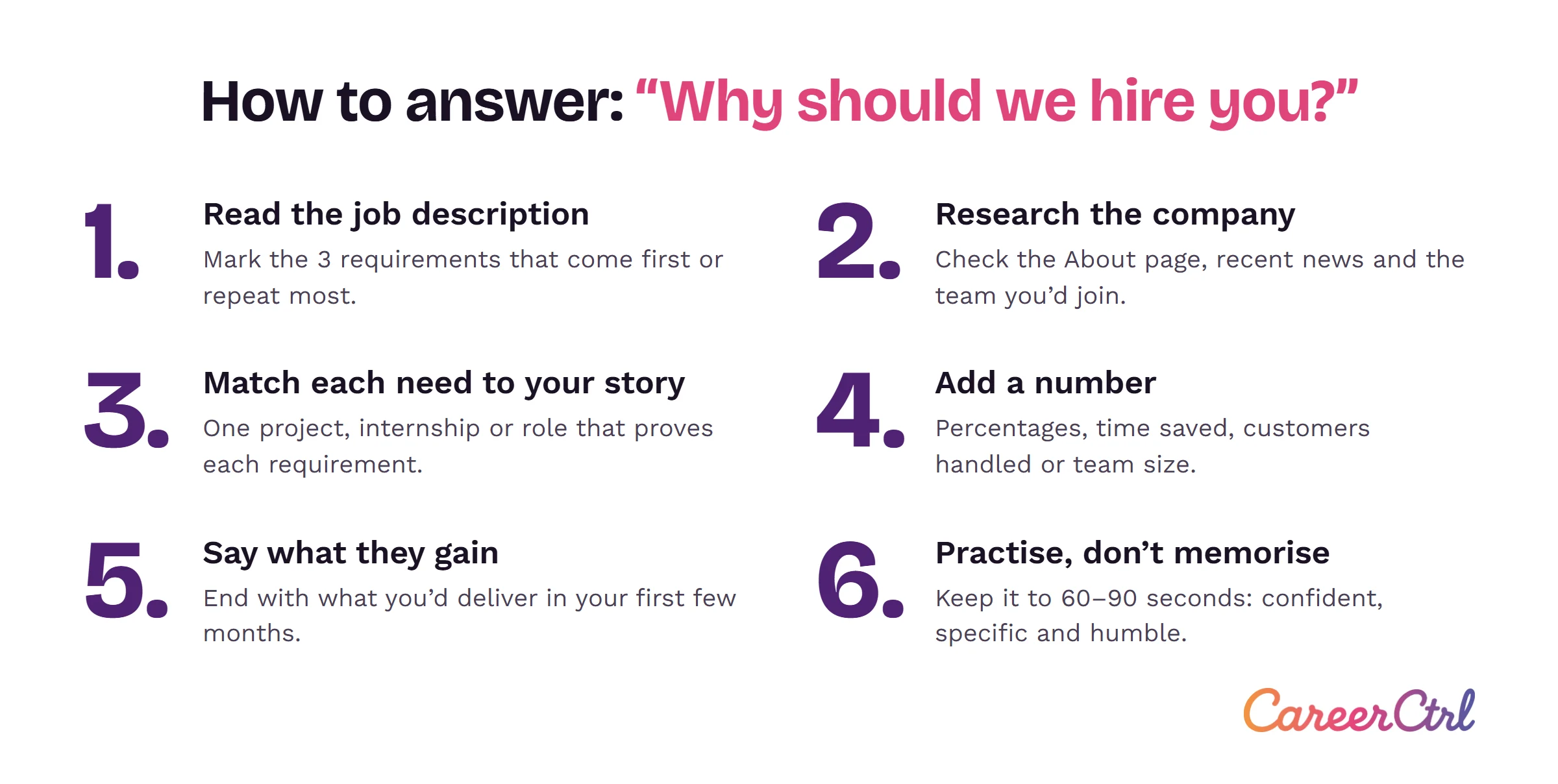
1. Read the job description twice
Mark the three requirements that come first or repeat most. Those are what the hiring manager cares about. If the posting says "communication" three times and "Excel" once, lead with communication.
2. Research the company
Read the About page, a recent product launch or news item, and the LinkedIn profiles of the team you would join. One specific detail, such as a new office, a product you use or a stated value, shows you did not apply on autopilot.
3. Match each need to your story
For each of the top requirements, pick one project, internship, role or achievement that proves you can do it. Freshers: final-year projects, internships, hackathons, college fests, freelancing and part-time jobs all count.
4. Add a number
Numbers make claims believable: percentages, time saved, customers handled, users, marks, team size or deadlines met. "Cut report time from two days to four hours" beats "improved efficiency" every time.
5. Say what they gain
Turn features into benefits. "I know SQL" is a feature. "I can take the weekly sales report off your team's plate in my first month" is a benefit. End your answer here.
6. Practise, don't memorise
Write three bullet points, not a script. Say the answer out loud a few times until it takes 60 to 90 seconds. Memorised answers sound robotic and fall apart when the interviewer interrupts.
The best answer formula: Need, Proof, Value
Every strong answer to "Why should we hire you?" has the same three parts, in this order:
- Need: what the role requires, in the employer's words. ("You need someone who can handle high-volume customer queries.")
- Proof: one or two real examples from your background, with a number. ("At my last job I handled 60 tickets a day at a 94% satisfaction score.")
- Value: what they get, and why you want to do it at this company. ("I can get productive quickly and help your team hit its response targets.")
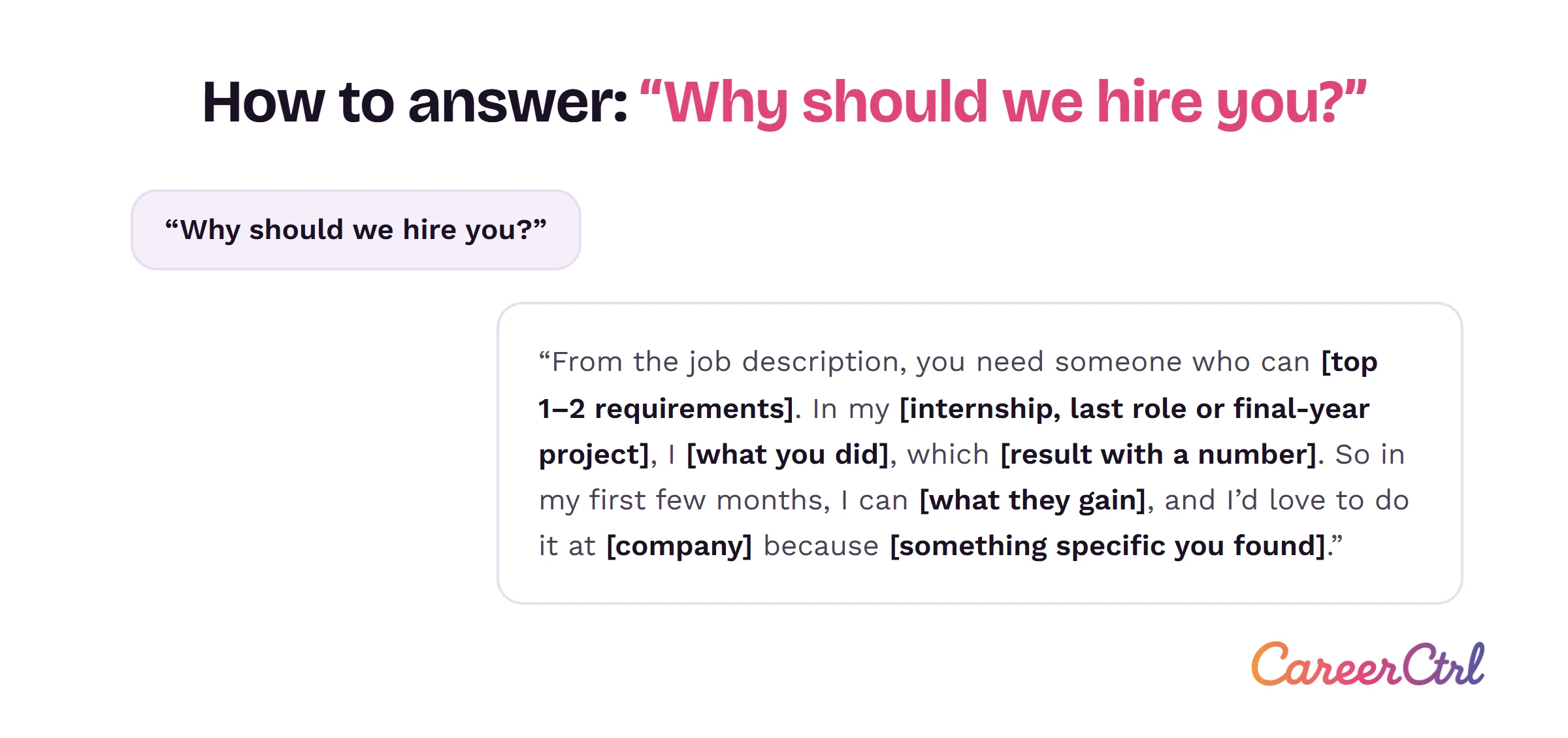
Here is the formula as a fill-in-the-blanks template. Replace each bracket with your own details, then trim until it sounds like you.
Why should we hire you: answers for freshers
As a fresher, you are not competing on years of experience. You are competing on proof that you learn fast and do the basics well. Use projects, internships, college roles and certifications as your evidence, and show you have done your homework on the company. For more on this, see how to get a job with no experience.
Why should we hire you: answers for experienced professionals
With experience, the bar rises: the interviewer expects results, not potential. Lead with outcomes you delivered that match their biggest problem, keep the numbers specific, and show you understand where the team is heading. The STAR method is useful if they ask you to expand on an example.
Mistakes to avoid when answering "Why should we hire you?"
Avoid
- "Because I'm hard-working, honest and dedicated" (everyone says this)
- "I need this job" or "This will help my career" (about you, not them)
- Reciting your whole resume, line by line
- Running down other candidates or your current employer
- "I'm the best candidate you'll find" (with no proof)
- Talking for three or four minutes
Do instead
- Name the job's top one or two needs in their words
- Give one real example per need
- Add a number to each example
- Mention one specific thing about the company
- End with what they gain from hiring you
- Stop at 60 to 90 seconds
How to answer related questions
"Why should we hire you over other candidates?"
You don't know the other candidates, so don't compare yourself to them. Instead, point to the combination of strengths that is unusual: for example, "Many people can code; I can also explain technical work to clients, which I did every week at my last job."
"Why shouldn't we hire you?"
Stay calm and be honest about a real limit, then show what you do about it. For example: "If you need someone who already knows SAP, I'm not there yet. I've started a course and I learn tools quickly; I picked up Tally in two weeks at my internship."
"What can you bring to the company?"
Answer it like "Why should we hire you?", but spend more time on the Value part: what you would build, fix or improve in your first six months. See our list of common interview questions and answers for the other questions that usually come in the same round.
Frequently asked questions
What is the best answer to "Why should we hire you?"
The best answer links the job's top requirements to your proof and ends with what the company gains. For example: "You need someone who can manage client accounts and reporting. I've handled 15 accounts and my weekly reports went out without edits for a year, so I can take ownership quickly."
How do I answer "Why should we hire you?" as a fresher?
Use projects, internships, college roles, certifications and part-time work as proof. Name one or two skills the job needs, give a real example of each with a number, and show that you learn quickly and have researched the company.
How long should my answer be?
Between 60 and 90 seconds, or about 120 to 200 words. That is enough for two pieces of evidence and a strong finish. If the interviewer wants more, they will ask a follow-up question.
Can I give a short, one-line answer?
Only if the interviewer asks for one. A one-line version could be: "You need someone who can [top need], I've done it at [place] with [result], and I can do the same for your team." In a normal interview, a 60 to 90 second answer works better.
Should I memorise my answer?
No. Memorise three bullet points (the need, your proof and the value), not a script. Practise saying it in slightly different words each time, so it sounds natural and survives an interruption.
Is it okay to say I am a quick learner or hard-working?
Only with proof. "I'm a quick learner" means little on its own. "I learnt Power BI in three weeks and built our team's sales dashboard" shows it.
Get started free: Build an ATS-friendly resume with CareerCtrl, tailor it to each job description and find roles that match your skills, with a free plan to start.