Applying to every job that looks vaguely right is tiring, and it rarely works. Each application deserves a resume tuned to that role, and you only have so many hours. Match scores help you decide where those hours go — if you read them as a guide rather than a grade.
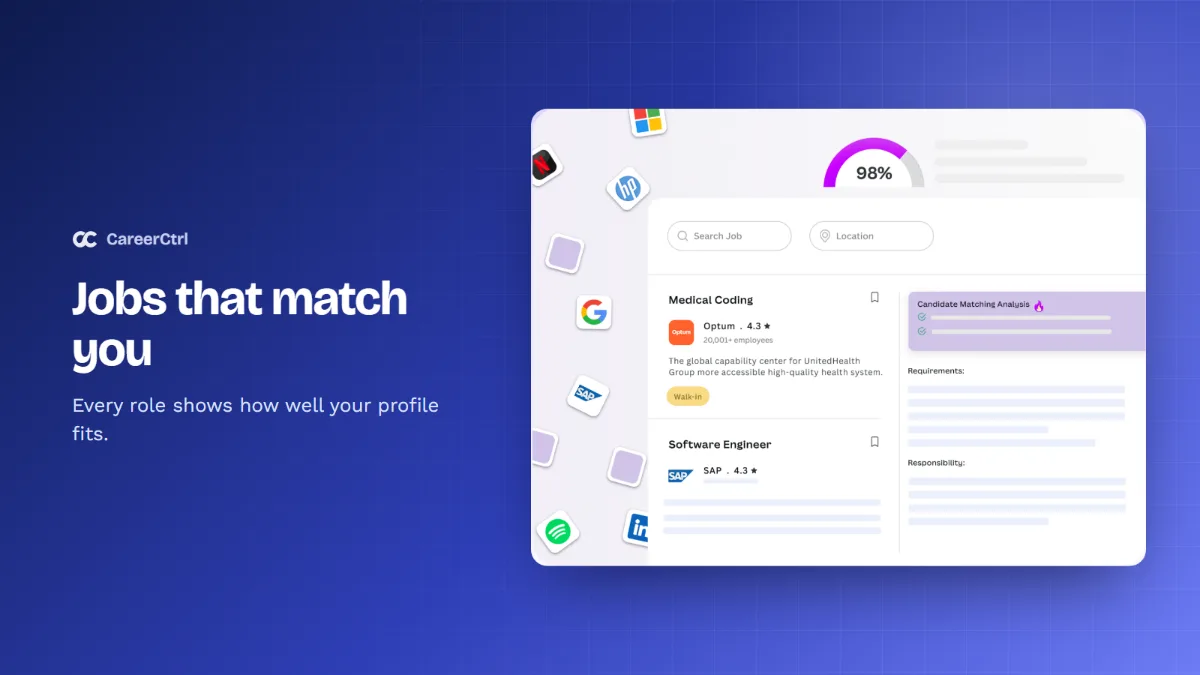
On CareerCtrl you will see two kinds. In Jobs, the For You list shows a match percentage on each opening, based on how your profile and skills line up with the job. In Resume Studio, the matching score compares a specific resume against a job description you paste in. The first helps you choose jobs; the second helps you tailor for one.
What a match score can and cannot see
A score can compare the skills, titles and requirements in a posting with what is in your profile or resume. It cannot see things that are not written down: a project you forgot to mention, a skill you have but described differently, or how much a hiring manager is willing to flex on a requirement.
So a low score has two possible meanings. Either the job is not a good fit, or your profile is not telling the full story. Before you skip a role you are excited about, check which one it is.
Sort jobs into three groups
Rather than treating the number as a pass mark, use it to sort openings into three groups, then decide how much effort each one gets.
| Group | When to use it |
|---|---|
| Apply now | a high match, and you meet the must-have requirements. Tailor the summary and top bullets, then apply the same day. Early applications tend to get read. |
| Tailor first | a middling match, but the gaps are wording rather than ability. Update your resume with the terms you genuinely have, re-check the score, then apply. |
| Skip for this round | a low match because of a hard requirement you do not meet, such as a licence, a specific degree or several years of a core skill. Save it and move on. |
Read the requirements, not just the number
Job descriptions mix must-haves and nice-to-haves, and they do not always label them. A useful rule: requirements in the first few lines, those repeated more than once, and anything phrased as "must" or "required" are usually firm. Long lists of tools at the end are often a wish list.
Close the gaps you actually can
When a resume's matching score is lower than you expected, look at which terms are missing. Often it is vocabulary: the job says "customer success" and you wrote "client support"; the job says "REST APIs" and you wrote "backend services". Where the meaning is the same and true, use the employer's wording.
What you should not do is paste in skills you do not have. You may push a score up, but you will be asked about it in the first interview, and a recruiter who catches it will not trust the rest of your resume.
Improve your profile once, benefit everywhere
For You recommendations come from your profile, so a few minutes spent there pays off on every future match. Add your full skill list, your preferred locations and work mode, and your current or target role. If the recommendations feel off, it is usually because the profile is thin.
A weekly routine that works
- Twice a week, open For You and save every role you would genuinely take.
- Sort the saved list into apply now, tailor first and skip.
- For each role you apply to, duplicate your base resume, paste the job description and tailor until the matching score reflects your real fit.
- Track where you applied and follow up after a week if the posting lists a contact.
Five well-chosen, tailored applications a week will usually get more replies than thirty generic ones. Match scores make choosing those five much faster.
Browse jobs: Browse openings across India, save the ones you like and see a match percentage on each role in For You.